Intel® Threading Building Blocks 2.1
|
Intel® Software Development Products for Intel® Platforms and Technologies |
|
|
Intel® Threading Building Blocks 2.1 |
|
|
|
 |
 |
||||||||||||||||
|
|||||||||||||||||
 |
 |
Intel® Threading Building Blocks is also available for Open Source.

|
|
This section graphically highlights the key benefits of Intel TBB. For a more comprehensive description of the features, click on the Features & Benefits button below to visit the open source site. |
||||
| Intel TBB offers comprehensive, abstracted templates, containers and classes for parallelism. Version 2.1 expands usage models and improves performance and usability. Figure 1 highlights the major functional groups within Intel TBB 2.1. Improved and new capabilities are highlighted in yellow. Be sure to go to New in This Release section for a more detailed description of the new capabilities within Intel 2.1. |
||||
|
||||
|
||||
 |
||||
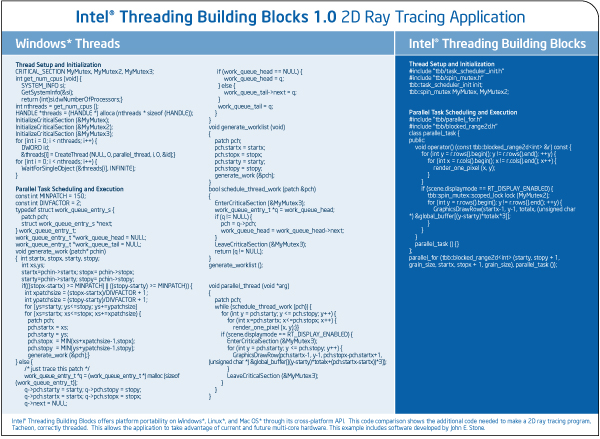
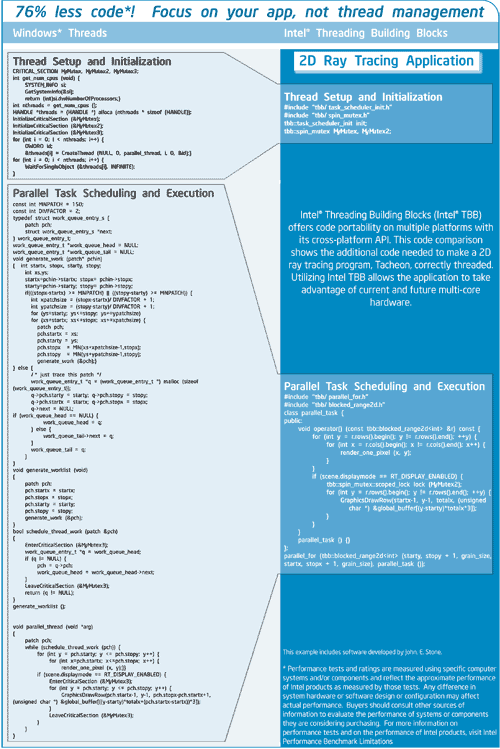
Figure 2. Side-by-side comparison of equivalent Windows* thread functionality that requires significantly more code to make a 2D ray tracing program, Tacheon, correctly threaded. Linux and Mac OSX developers can expect similar results. |
||||
 |
||||
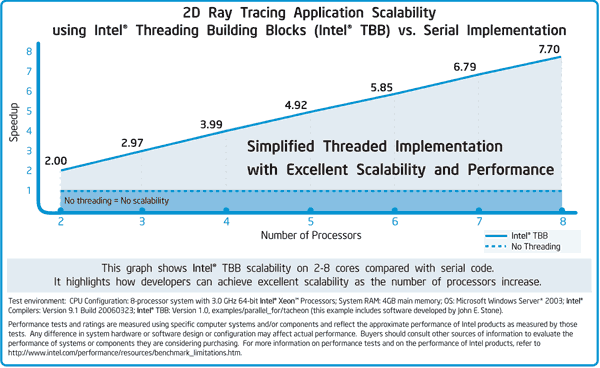
Figure 3. Excellent scalability and improved performance using Intel TBB versus a serial implementation. Linux and Mac OS X developers can expect similar results. |
||||
| back to top
|
|
Intel TBB 2.1 offers considerable improvements above 2.0 through pivotal functionality, performance, and usability enhancements. |
||||
Do more: Intel TBB 2.1 enables new use cases by allowing developers to create threads that don’t interfere with working tasks. Now Intel TBB can be more generally applied to cross-platform applications which need the benefit of threading in both computational and interfacing components. Use Intel TBB to work with GUIs, AI, I/O operations, and network events without blocking ongoing computation being done by other active tasks. |
||||
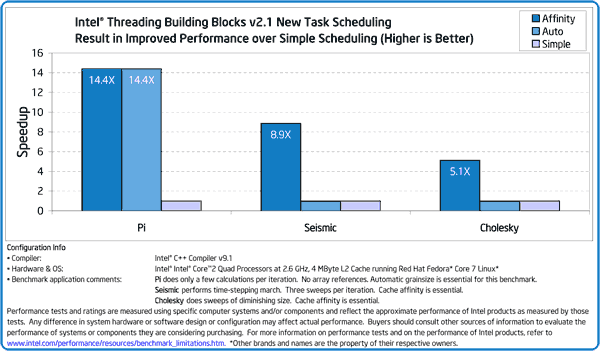
Do it faster: Intel TBB 2.1 has significantly improved performance on workloads which benefit from static scheduling. Now Intel TBB’s work-stealing task scheduler more efficiency prioritizes work to reduce unnecessary task stealing. Use Intel TBB to abstract from thread maintenance and be assured of great performance no matter what workload your algorithm works on. |
||||
|
||||
Figure 4. Benchmarks highlight how the auto and task affinity scheduling available in version 2.1 can significantly improve performance over simple task scheduling that was the only choice in the previous version. Developers get performance benefits with minimal or no code changes because of the continued |
||||
Do it easier: Intel TBB 2.1 makes it easier to use in Microsoft Visual Studio* by offering a compile configuration plug-in. Now Intel TBB makes it simple to configure different compilation variables for multiple development phases including debug and production. |
||||
| For a more comprehensive description of Intel TBB 2.1 features, click on the New In This Release button below to visit the open source site. | ||||
| back to top
|
|
Intel TBB is cross-platform (Windows, Linux, and Mac OS X), supports 32-bit and 64-bit applications and works with Intel, Microsoft and GNU compilers. Intel TBB is specifically designed to work in concert with other threading technologies, such as Win32*, POSIX*, and OpenMP* threads, providing a high degree of design and development flexibility. The templates implemented in Intel TBB rely on generic programming in order to provide high-speed and flexible algorithms with very few implementation constraints. |
||||
Hardware - Recommended |
||||
 |
Microsoft Windows*: Intel® Core™ 2 Duo processor or Intel® Xeon® processor or higher |
|||
| |
Linux*: Intel® Core™ 2 Duo processor or Intel® Xeon® processor or Intel® Itanium® processor or higher |
|||
|
Mac OS* X: Intel® Core™ 2 Duo processor or higher |
|||
| Hardware – Supported | ||||
| |
Intel® Pentium® 4 processor family |
|||
| |
Intel® Pentium® D processor family |
|||
|
Intel® Xeon® processor family |
|||
|
Intel® Core™ processor family | |||
|
Intel® Core™ 2 processor family |
|||
|
Intel® Itanium® processor family (Linux* systems only) |
|||
|
Non Intel® processors compatible with the above processors |
|||
| Software - Minimum Requirements | ||||
|
Supported operating system (see below) |
|||
|
Supported compiler (see below) |
|||
|
Xcode* tool suite 2.4.1 or higher (Mac OS* X systems only) |
|||
|
Microsoft* Internet Explorer* 6.0, or other compatible web browser |
|||
|
Adobe® Reader®* 6.0 or higher |
|||
Software – Recommended |
||||
| |
Intel® C++ Compiler 10.0 or higher |
|||
|
Intel® Thread Checker 3.1 or higher | |||
| |
Intel® Thread Profiler 3.1 or higher |
|||
| Software - Supported Operating System | ||||
| Windows | ||||
|
Microsoft* Windows* XP Professional |
|||
|
Microsoft* Windows* Server 2003 | |||
|
Microsoft* Windows* Vista | |||
Linux |
||||
|
Red Hat* Enterprise Linux* 3, 4, 5 (when using Red Hat* Enterprise Linux* 4 with Intel® Itanium® processors, operating system Update 2 or higher is recommended) | |||
|
Red Hat* Fedora* Core 5, Core 6, 7, 8 (not with Intel® Itanium® processors) | |||
|
Asianux* 3.0 | |||
|
Debian* GNU/Linux* 4.0 | |||
|
Ubuntu* 7.04, 7.10 | |||
|
SuSE* Linux* Enterprise Server (SLES) 9, 10 | |||
|
SGI* Propack* 4.0 (with Intel® Itanium® processors only) | |||
|
SGI* Propack* 5.0 (not with IA-32 architecture processors) | |||
|
Turbolinux* GreatTurbo Enterprise Server 10 SP1, Turbolinux* 11 (not with Intel® Itanium® processors) | |||
Mac OS X |
||||
|
Mac OS X 10.4.9 or higher | |||
Software - Supported Compilers |
||||
Windows |
||||
|
Microsoft* Visual C++* 7.1 (Microsoft* Visual Studio* .NET 2003, Windows* systems only) | |||
|
Microsoft* Visual C++ 8.0 (Microsoft* Visual Studio* 2005, Windows* systems only) | |||
|
Microsoft* Visual C++ 9.0 (Microsoft* Visual Studio* 2008, Windows* systems only) | |||
|
Intel® C++ Compiler 10.0 or higher | |||
Linux |
||||
|
For each supported Linux* operating system, the standard gcc version provided with that operating system is supported, including: 3.2, 3.3, 3.4, 4.0, 4.1 | |||
Mac OS X |
||||
|
|
For each supported Mac OS* X operating system, the standard gcc version provided with that operating system is supported, including: 4.0.1 (Xcode* tool suite 2.4.1 or higher) | |||
| back to top
|
|
With the purchase of Intel TBB, you will receive one year of technical support and product updates from Intel® Premier Support, our interactive issue management and communication web site. This premium support service allows you to submit questions, download product updates, and access technical notes, application notes, and other documentation. For more information, visit the Intel Registration Center. |
|||
| back to top
|

 Print
Print